From TMA’s News Bulletin 1st Q 2026 –
The refreshed “TMA 2.0” will differ in many ways, but its original 1925 mission of “promoting the business interests of TMA members and improving members’ social and industrial relationships in order to foster the exchange of courtesies” will remain.
As 2026 begins, the world has turned its attention to the urgent need for stable supply chains, strong national security, and a well-trained, skilled workforce. All of these topics involve manufacturing as an industry and, more specifically, TMA as an association.
Some people point to the root of this renewed global emphasis on manufacturing to the 2020-2022 COVIDrelated supply chain crisis. Others point to the increased awareness of the risks of relying on hostile countries for critical pharmaceuticals and rare minerals.
While automation has somewhat eased the strain on a shrinking skilled workforce, a renewed outcry for proficient machinists, electricians, builders, and plumbers is reaching new heights.
The United States has a renewed focus on reshoring manufacturing and seeks to return to being a global leader. Countries all over the world are now investing in manufacturing in the United States.
The Trump Administration reports that, as of the beginning of 2026, many US companies and foreign countries, including the UAE, Qatar, Japan, India, and Bahrain, have promised or begun investing nearly $10 trillion in the US manufacturing industry over the next five years.
TMA Contemplates New Ideas in Its Second Century
TMA was a part of America’s first Industrial Revolution in the early 1920s.
The Association is working towards keeping that heart beating with new ideas, methods, and techniques to continue our mission and purpose – just as the vast majority of the TMA members have had to do in their individual facilities over the past 100 years.
However, failing to adapt to industrial and technological developments can be fatal to any entity’s longevity.
The environment is competitive, not just with other associations, but also with private-sector organizations. It is very competitive with technology. That calls on 100-year-old organizations to think differently about everything they do. They must create new things and be the forward thinkers for small and midsize manufacturers.
Small and midsize manufacturers, often legacy operations and mom & pop shops, face unique challenges – and that niche is what TMA is focused upon.
TMA members are not the Boeings or the Caterpillars. They do not have vast sums of money or entire departments, floors, buildings, and people sitting around, exploring new ideas and conducting R&D on these innovative concepts. TMA continues to be ground-breaking for their members’ business welfare.
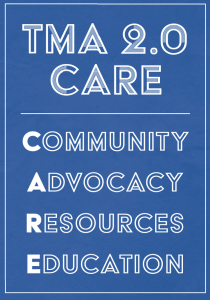
TMA C.A.R.E.
TMA 2.0’s emphasis will be focused on C-Community, A-Advocacy, R-Resources, and E-Education – C A R E. TMA cares about its members and their success. The organization strives to assist them in every way possible to reach their goals.
In addition to TMA’s in-person programming, TMA will build and expand its online SIG connecting system. TMA’s SIG system is an online group email loop that enables TMA members to ask industry questions, request recommendations, post job opportunities, and seek colleagues’ opinions. It is one of TMA’s most powerful connecting resources – and it’s available only to TMA members.
TMA 2.0 will also have an even more active A-Advocacy benefit.
TMA’s Advocacy Team has been working for several years to amplify the voices of small- and midsize manufacturers in the Midwest, especially in Illinois. The Illinois General Assembly — for the first time ever — has a sizable bipartisan group of state lawmakers, the SaMM Caucus (Small and Midsize Manufacturing Caucus), committed to encouraging small and midsize manufacturers.
It is crucial that manufacturers have a voice that is heard and respected in the Illinois General Assembly. Small and midsize manufacturers make up the majority of manufacturing businesses – and they need to be represented in Springfield as strongly as the big businesses are. TMA will work hard in a tough environment for its members’ sake.
TMA’s R-Resources will continue to be developed and offered to TMA members, but in a more individualized way. The goal is to eventually personalize TMA’s services and resources to match individual companies’ needs. Connections will be the key.
E-Education, the fourth segment of TMA’s CARE theme, takes the focus of the organization’s update.
TMA is re-examining how training should best be delivered in the 2020s. It’s different from the methods and curriculum used fifty years ago. Technology has enabled a training system to not be constrained by geography. The Association’s developing system will be specialized, customized, and offered just-in-time, meeting the TMA member/customer where they are.
Such an advanced system can include studying specific topics online and using virtual reality at the students’ convenience. When hands-on machining experience is required, TMA training can be delivered at the student’s location, making the training more convenient for the student, the employer, and the trainer.
What Lies Ahead at TMA
TMA strives to adapt to the next generation’s learning styles and to appeal to their interests for the future of the US manufacturing industry. That will take courageous moves and daring concepts.
The point is that many changes are being proposed and considered for TMA in its second century. However, there’s no question that the original mission of serving small and midsize manufacturers in Illinois and beyond will remain TMA’s focus going forward.
So, get ready to upload TMA’s newest version – it will be the best yet!
From TMA’s 1st Quarter 2026 News Bulletin. By Fran Eaton, News Bulletin editor