
SCHAUMBURG – Four years ago, Illinois set a goal of achieving net-zero electricity generation by 2050, with targets of 40% renewable energy by 2030 and 50% renewable energy by 2040. To meet those standards, numerous changes will need to take place – at a time when global energy demand is expected to reach its highest point in human history.
“Renewable energy” is preferred over “fossil fuels” among those directing Illinois’ government policy. Renewable energy sources include the sun and wind. Fossil fuels come from coal, gas, and oil – sources that are good while they last, but not so good if users deplete the supply.
Nuclear energy is considered renewable, but many are concerned about its safety and the disposal of waste.
As of last year, the U.S. Department of Energy reports that Illinois – a once coal-rich, nuclear-embracing entity – has a long way to go to meet the energy mandates it set when the Illinois General Assembly passed the Climate & Equitable Jobs Act (CEJA) in 2021.
With 25 years to meet those mandates, dramatic changes will be needed, as Illinois’ electricity in 2024 came from 54% nuclear, 18% gas, 15% coal, 13% wind, and 1% commercial solar units.
The current Illinois energy policy requires coal and natural gas plants to end operations in 20 years.
At the same time, fossil energy resources are shutting down, and high-energy-demanding data centers are joining the state’s electrical grid system. The new demands on an already strained power system are driving up the costs for the residents and businesses of Illinois. Once an energy-exporting state, Illinois is now importing energy sources from beyond its borders.
TMA members speak out on the energy dilemma
At the end of Summer 2025, when most Illinoisans received higher energy bills, TMA members began sharing with the TMA Advocacy Team how their electric rates soared over the past few years.
“Policies are just nuts in Illinois, making it harder and harder to compete and hold pricing in a very price-sensitive economy,” one TMA member said about his electric bills.
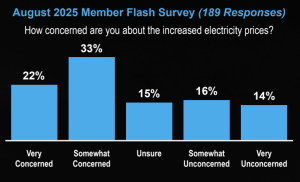
For the most part, TMA members have two- and three-year contracts with utility distributors, with the goal of achieving lower energy bills. In August, when they asked how concerned they were about increased electricity prices, more than half of TMA’s responding members, 55%, said they were concerned about the increased energy prices, with 22% being “very concerned,” as the higher energy costs had already forced budget cuts. 33% said they are “somewhat concerned.”
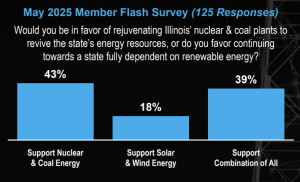
When asked in May 2025 if they would be in favor of rejuvenating Illinois nuclear and coal plants to revive the state’s energy resources, or if they favor continuing toward the state’s full dependency on solar and wind energy, 43% of TMA’s responding members were in favor of Illinois taking advantage of the state’s nuclear and coal energy sources. 39% were in favor of a combination of all currently available energy sources, as well as those that will be available in the future. Just 18% of small and midsize manufacturers were in favor of Illinois staying the course to full dependence on solar and wind energy by 2050.
“The rising electricity costs are a significant concern for our manufacturing members, with over half expressing worry about the impact it will have on their operations and their employees,” said TMA Executive Vice President Dennis LaComb.
“This issue extends beyond the factory floor, as employees are also grappling with higher energy bills at home, exacerbating the cost-of-living problem. TMA is advocating for bipartisan solutions that will make energy in Illinois more reliable and affordable. Indeed, in May 2025, 82% of TMA manufacturers said they supported an energy plan that included nuclear and coal energy sources.”
Differing viewpoints determine Illinois’ energy future
The Citizens Utility Board (CUB), however, is holding firm on supporting the CEJA green-energy-mandating 900-page law that CUB lauds as a “national model on how states can fight the most devastating and expensive consequences of climate change.”
In a recent Illinois Senate hearing on energy, the Democratic majority allowed only one witness to share a critical perspective on CEJA, which requires coal and natural gas plants to shut down by 2045 and be replaced with wind, solar, and grid batteries.
Steve Goreham, executive director of the Climate Science Coalition of America, and author of four books on the issue, told the Senate Energy Committee, “First, if Illinois is somehow able to achieve net-zero electrical power emissions by 2050, it will not have a measurable effect on global or even national emissions.
Today, Illinois emits approximately 180 million metric tons of carbon dioxide each year, which accounts for less than 0.4 percent of global emissions. Coal provides 35% of the world’s electricity, the largest source. More than 6,500 coal-fired power plants currently operate worldwide, with another 1,000 plants in planning or under construction, dwarfing Illinois’ netzero efforts, he told the committee.
“Because of the AI revolution, power systems are striving to meet huge new demand. Nuclear plants are being restarted. Coal plants scheduled for closure are being extended in Georgia, Indiana, Tennessee, Utah, West Virginia, and other states. Hundreds of natural gas plants are in planning or under construction,” Goreham said.
Goreham went on to tell the lawmakers that Illinois’ net-zero efforts will use vast amounts of land and will raise power prices for Illinois residents.
“Wind and solar facilities use 100 times the land of coal, gas, or nuclear plants for the same average power output. Because wind and solar are spread over wide areas, two or three times as much transmission must also be constructed. Because of intermittency and transmission needs, deployment of wind and solar increases the cost of power,” he said.
In the closing hours of the October Veto Session, the Illinois General Assembly passed an extensive energy package, supported along party lines.
State Senator Bill Cunningham (D-Chicago) supported the measure, saying the policies within will keep the cost of energy down over the next two decades.
“Nationwide, we’ve seen electricity bills skyrocket this summer,” said Cunningham, a Democrat who represents portions of Chicago and the Southwest Suburbs. “Without meaningful relief, this trend will continue – leaving families and small businesses to foot the bill for a broken system.”
The Democrat said the measure going to Governor Pritzker’s desk aims to give Illinois new tools to reduce utility rate hikes, strengthen the state’s power grid, expand renewable energy sources, and keep bills low for consumers. The measure contains multiple provisions to tackle rising energy costs while transitioning Illinois to a cleaner, more reliable grid.
The legislation incentivizes measures that lower electricity prices by addressing demand for energy and increasing grid capacity through initiatives such as energy storage. Battery storage lowers costs over time — meaning consumers will be on track to save more than $13 billion over the next 20 years with the added three gigawatts of energy storage provided by Senate Bill 25.
“Taking action with energy relief will reduce rate hikes and save customers billions — proving that we don’t have to choose between investing in new technologies, lowering utility bills, and keeping clean energy jobs in Illinois,” Cunningham said.
Which viewpoint will become reality in Illinois remains to be seen. The CEJA goals are unrealistic, some say. The CEJA mandates are unachievable within the expected time frame, others say. The costs will overrun the plans eventually, and it will all be for naught, still others say.
However, there is no doubt that for small and midsize manufacturers who say that utility costs are second only to wage requirements among their company’s annual expenses, energy costs will be crucial.
But will manufacturers join the conversation to determine the future?
They must do so, says Jim Vinoski, Forbes contributor and host of the Manufacturing Talks podcast. Writing about the state of Michigan’s skyrocketing energy costs as the state’s green energy plan, similar to Illinois’, is implemented, Vinoski writes on Substack that he’s shocked by the complacency of the industry.
What do the owners of the largest Michigan iron mine, being forced to close, , say about it? Vinoski asked. He answered the question with:
Nothing. Nor has any other manufacturer in Michigan that I’m aware of made the slightest peep about the astonishing cost increases they will all face from this regulatory insanity.
… Michigan is by no means alone when it comes to ruinous energy policies. Fully half of American states have similar clean energy mandates.
So, for all the happy talk of reshoring and reindustrialization, the fact is that American manufacturing competitiveness will soon be plummeting in half the country, thanks to increasingly costly and less reliable generation of that industrial lifeblood, electrical power.
Where are our manufacturing leaders in this discussion?
Energy reliability and cost is a vast, complicated topic with an unlimited array of opinions and insights. What small and midsize manufacturers think about it does matter.
Feel free to share your thoughts on the issue with TMA News Bulletin by writing info@tmaillinois.org. Let’s get the discussion going.
From TMA’s Winter 2025 News Bulletin by editor Fran Eaton.