
From Coalition for a Prosperous America:
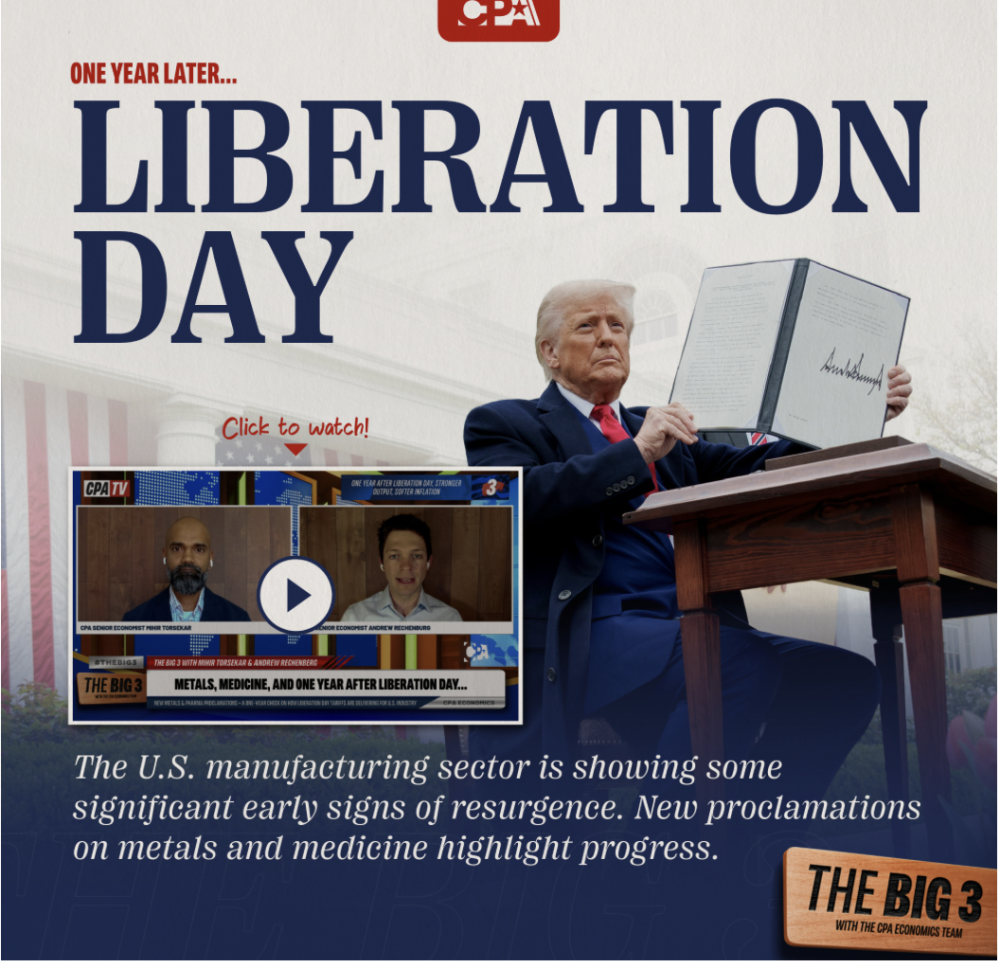
Late last week, President Trump issued Section 232 proclamations imposing new tariffs on patented pharmaceuticals and restructuring duties on steel, aluminum, and copper to protect U.S. national security.
Domestic steel and aluminum industries—especially downstream manufacturers—play a critical role in supporting high-quality jobs and value-added production across the U.S. economy. Consumer goods, from appliances to barbecues, from gun safes to flatware, also play an important role in sustaining American aluminum, copper, and steel production.
Additionally, rebuilding domestic capacity for pharmaceuticals and APIs is not only an economic priority—it is a national security imperative. These products are foundational to public health, emergency preparedness, and military readiness, and disruptions in supply can have immediate and severe consequences.
ON METALS…
CPA applauded the Trump administration for issuing a proclamation that strengthens the Section 232 tariffs on steel, aluminum, and copper. Importantly, today’s action eliminates the “tariff on content” customs valuation approach which was undermining the effectiveness of the tariffs. Going forward, the tariffs will now be applied to the full customs value of imported products.
These changes address concerns raised by domestic manufacturers regarding tariff circumvention, import undervaluation, and enforcement gaps. By replacing the flawed “tariff on content” approach with full-value tariffs and strengthening enforcement tools, the administration is closing pathways that allowed foreign producers to evade duties and undercut U.S. industry. The proclamation also repeals the public inclusion process, but preserves the ability for downstream products to be added.
CPA and its metal fabricator members—particularly in the steel pipe and tube sector, which has been heavily impacted by import surges and undervaluation, the aluminum fabricator industry, which represents the overwhelming majority of jobs in the domestic aluminum sector, and domestic copper manufacturers—have engaged extensively with senior administration officials to highlight how current policies were allowing imports to displace domestic production despite the presence of tariffs. The proclamation also maintains the 50 percent tariff rate on core upstream copper products such as bars and plates, ensuring that foundational protection for domestic producers remains intact.
In particular, CPA and its members are grateful to Undersecretary of Commerce Jeffrey Kessler, who leads the Bureau of Industry and Security, and his team for their work and support for domestic industry. The proclamation reflects a recognition that effective trade policy requires not only strong measures on paper, but also straightforward implementation. The proclamation’s revised ad valorem approach will help lessen the flagrant undervaluation that has exploded since June 2025.
CPA PRESIDENT JON TOOMEY SAID: “After in depth engagement with senior administration officials to address critical flaws in the Section 232 steel and aluminum tariffs, we are grateful they are taking this important action. We especially appreciate the leadership of the Bureau of Industry and Security and the work their team has done to resolve these issues. CPA is proud to represent companies across the steel and aluminum industries that account for the vast majority of jobs in these critical sectors, and this action will help ensure these tariffs function as intended to support domestic production and American workers.”
ON MEDICINES…
CPA applauded the Trump administration for advancing Section 232 action on pharmaceutical imports, a critical step toward strengthening domestic production of pharmaceuticals and active pharmaceutical ingredients (APIs) and improving U.S. health security.
The proclamation recognizes that the United States remains heavily dependent on foreign supply chains for pharmaceuticals and their key inputs, particularly APIs, exposing patients and providers to supply disruptions, quality risks, and geopolitical vulnerabilities. In 2002, U.S. manufacturers produced 83.7 percent of the pharmaceuticals consumed domestically. By 2024, that number plummeted to just 37.1 percent. China alone produces roughly 80–90 percent of key antibiotic API inputs, creating a concentrated upstream chokepoint in the global supply chain. The administration’s action—focused on patented drugs and associated inputs—marks an important acknowledgment that pharmaceutical import dependence poses a national security risk.
CPA has long urged action in this area, including through its formal comments on the Section 232 investigation to the Department of Commerce outlining the national security risks posed by import dependence and the need to restore domestic production. CPA has emphasized that rebuilding U.S. pharmaceutical manufacturing requires a comprehensive approach that includes both patented drugs and generic medicines.
CPA PRESIDENT JON TOOMEY: “Today’s action is a meaningful step toward restoring America’s ability to produce critical pharmaceuticals and APIs. For too long, the United States has relied on fragile and subsidized foreign supply chains for these essential products. Section 232 gives the administration the tools to rebuild domestic manufacturing, strengthen supply chain resilience, and reduce dependence on foreign adversaries.”
While the proclamation takes important action on patented pharmaceuticals, it does not yet apply tariffs to generic drugs and their associated ingredients, which account for the vast majority of prescriptions filled in the United States. The administration has directed further review of generic imports, creating an opportunity to take additional action to address vulnerabilities across the full pharmaceutical supply chain.
CPA’s research demonstrates that reshoring generic drug and API production is both necessary and achievable. Targeted tariffs on generic drugs can support domestic production without raising costs for patients, while creating the stable market conditions needed for long-term investment. CPA has also outlined policy frameworks—modeled on successful domestic industries—that can accelerate the rebuilding of a resilient, U.S.-based pharmaceutical supply chain.
Rebuilding domestic capacity for pharmaceuticals and APIs is not only an economic priority—it is a national security imperative. These products are foundational to public health, emergency preparedness, and military readiness, and disruptions in supply can have immediate and severe consequences.
CPA has also emphasized that rebuilding domestic capacity requires aligning trade policy with healthcare policy. In recent comments to CMS and HHS, CPA urged the administration to use Medicare’s purchasing power to support U.S.-based production, noting that payment policies must reflect the true cost of domestic manufacturing and create stable demand for U.S. producers. Together with Section 232 action, these reforms can ensure that federal healthcare spending reinforces—rather than undermines—the rebuilding of America’s pharmaceutical manufacturing base.
RELATED CPA PUBLICATIONS
- March 31, 2026: CPA Urges CMS, HHS to Boost Domestic Production of Generic Pharmaceuticals
- May 20, 2025: CPA Comments on Section 232 Investigation of Pharmaceutical Imports
- October 21, 2025: Testimony for Senate Special Committee on Aging: Bad Medicine — Closing Loopholes that Kill American Patients
- October 7, 2025: Pharmaceutical 232 Must Cover Generic Drugs to Fulfill President’s Promise of Reshoring Essential Medicine Production
- August 27, 2025: New CPA Report Shows Generic Drug Tariffs Will Not Raise Prices for Patients
- October 22, 2025: To Reshore Generic Drugs, Use Sugar’s Sweet Model