
By John F. Di Leo –
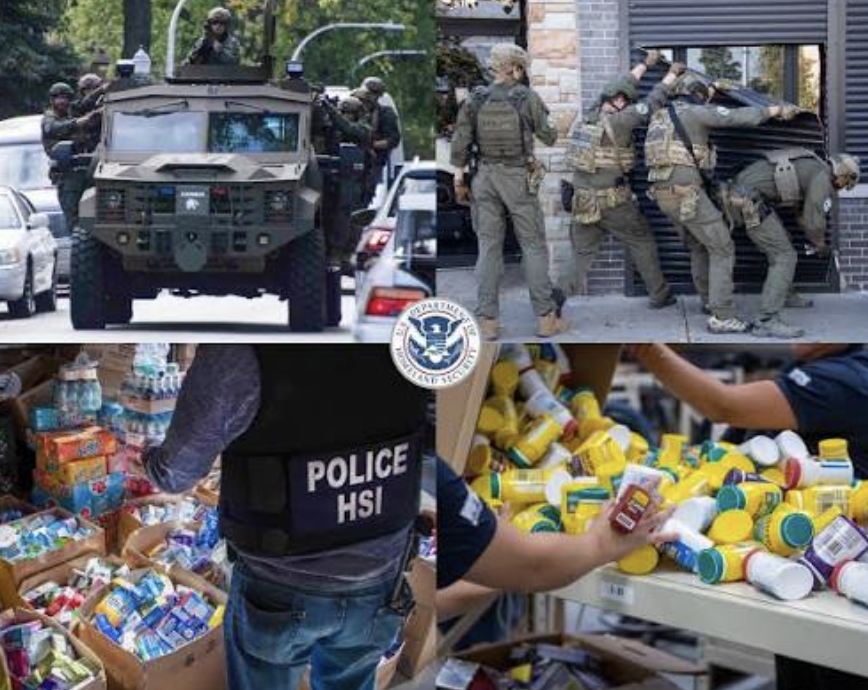
Trade fraud hit the headlines on Tuesday, July 14, when a joint press conference headed by the U.S. Department of Justice was held in the Chicago suburb of Bensenville, Illinois, announcing that the federal Trade Fraud Task Force has reached $1 billion in fines, penalties, judgments and additional tariff collections in the year since the task force was established – and it was a Chicago case that put them over the top.
On the bright side, not all those billion dollars in fines, etc. were racked up in Chicago.
But yes, part of the point of the press conference was that Chicago is one of the largest ports in the country, so there’s an enormous amount of illegal activity in Chicagoland for agents to find if they dig enough. And yes, they are digging now.
In theory, there are two kinds of crimes: those the perpetrator knows that he’s committing, and those the perpetrator doesn’t know that he’s committing.
The government is going after both groups – the ones who knowingly violate the law, on purpose, to cheat their fellow Americans, and the ones who may themselves be honest but careless, and have unknowingly chosen corrupt vendors, customers, distributors or agents who take advantage of their naivete. Or perhaps there’s a third group, consisting of honest businesses that employ the occasional corrupt buyer, salesman, engineer or accountant, who seeks to look like a winner for his employer and doesn’t care how he gets there.
The average businessman will say, “This news story doesn’t affect me, because I’m not a smuggler. I don’t lie to Customs about the nature, or cost, or volume, or origin of the goods I’m importing, or maybe I’m not even an importer at all, so this doesn’t apply to me.”
And that may be true.
But it probably isn’t, because most companies don’t realize how far out of compliance they are – not intentionally, but just due to bad luck and a lack of training and processes.
The modern supply chain has grown so diverse and so complicated, and the number of modern regulations has grown so overwhelming, it’s impossible for most companies to be sure they are following all the rules, unless they have rigorous internal training programs, work closely with their brokers, forwarders, and other supporters, and choose their vendors far more carefully than they realize is needed.
Most multibillion-dollar conglomerates, well aware of this risk, have very robust internal training programs, built into their legal, quality, or internal audit departments. But other than those huge publicly traded companies, most companies lack such processes and protections, putting us all at risk.
Examples From Recent Headlines:
In both the subject press conference and other recent announcements, the DoJ has provided a range of examples to demonstrate the variety of crimes on which they are focusing.
The Boise Cascade case, in which an American reseller was fined $6.4 million this year for having trafficked in mislabeled, illegally transshipped goods, accepting their vendor’s claim that the goods were Malaysian while presumably knowing they were actually Chinese – in violation of both United States Customs regulations and the Lacey Act.
The Jamshid Ghomi case, in which a number of American businesses, not all yet made public, were found to have shipped restricted goods to this Iranian-American business, who subsequently shipped them to his partners in the Islamic Revolutionary Guard Corps of Iran – in violation of the various Departments of State, Treasury, and Defense regulations known as the United States Export Controls.
The Williams Sonoma case, in which an American wholesaler and retailer, already on probation, was fined $3.4 million plus for selling foreign goods while marking them as USA origin – in violation of both Customs and Federal Trade Commission origin marking regulations.
The Raj and Veena Kohli case, and the almost identical Barkha Wholesale case, in which importers of jewelry from India and the United Arab Emirates falsely claimed the goods to be of Singapore or Oman origin, to defraud our government of tens of millions of dollars in duties by abusing our Free Trade Agreements.
The Perfectus Aluminum case, in which a California importer brought in
Chinese aluminum extrusions disguised as pallets, in order to evade the heavy anti-dumping and countervailing duties that the United States places on certain goods from countries (usually China, but not exclusively) that subsidize their exporters to sell goods far below cost, in order to illegally undercut American domestic production. The total settlement in this case – violations of Customs and International Trade Administration regulations and the False Claims Act – totaled over half a billion dollars to be paid to the federal government.
That’s a lot of fraud.
And it’s just the tip of the iceberg.
Could This Happen To Me?
If we look at the products alone, it’s easy for most companies to assume these issues don’t apply to them. “I don’t import aluminum extrusions, or dish towels, or jewelry, or any of the products in these news stories” or “I don’t sell goods that anyone in Iran, or North Korea, or Russia, or any other sanctioned nation’s military might want.”
But that’s not the way to look at it.
International trade is primarily based on a number of common themes: full and accurate descriptions of the goods, correct Customs classification, accurate and comprehensive value, and country of origin. The rules governing these subjects apply to all products, to and from all countries.
Smuggling isn’t just about illicit drugs and top-secret technology. It’s usually about falsifying values, origins, and descriptions in order to evade Customs duties or other tariffs, fees and taxes. It’s about lying to the consumer about something the consumer cares about. It’s about bypassing consumer safety protections like the Hazardous Materials regulations and endangered species restrictions, FDA-approval of foreign facilities and EPA registration of dangerous chemicals.
And it’s also about violating a host of other regulations of which an importer may not even be aware. A vendor might mark a product with the wrong country of origin because he just thinks it will sell better that way. A vendor might leave free samples or warrantee replacements off the invoice because he just incorrectly assumes that free stuff wouldn’t matter. A vendor might not mention a tooling downpayment, a customer-provided mold, or customer-provided components on the invoice because he generally might not know that these costs are dutiable too.
The Customs Modernization Act of 1993 almost feels like ancient history today, but it’s more relevant than ever. This is the law that clarifies how almost all responsibility for compliance with these kinds of rules is on the shoulders of the importer or exporter. The Mod Act introduced two rather vaguely defined terms – Reasonable Care and Informed Compliance – and directed that these responsibilities cannot be off-loaded onto the shoulders of a Customs broker, freight forwarder, carrier or other outside representative. Simply hiring a broker/forwarder to file documents for us doesn’t absolve us of responsibility, because the law knows that broker/forwarders are not mind-readers. The importer and exporter need to know the rules, and know when to declare information to the broker filing his documents.
So, yes, virtually all importers and exporters are at risk of these kinds of violations, because most companies – believing themselves so honest or small that the government would never take an interest in them – haven’t trained their staffs to be aware of these issues.
They just assume that hiring a broker or forwarder to file their import/export documents for them is enough.
Thousands of prosecutions per year show that it’s not.
What’s Different This Year?
Most of these audits and prosecutions have always taken place; they’re not new. Customs and Border Protection (CBP) looks for red flags in import shipments; the Office of Foreign Assets Control (OFAC) looks for red flags in export shipments; the Federal Trade Commission (FTC) looks for red flags on goods and packages sold domestically. And there’s cross-department cooperation too; the IRS gives a heads-up to Customs when performing a tax audit, and Customs gives a heads-up to the IRS when discovering something odd in a container inspection or import document review.
What’s new is the organization of a federal Trade Fraud Task Force, led by Justice, with a charter to focus on all forms of trade-related fraud, providing global resources to investigations, empowering agencies to add personal civil and criminal penalties when appropriate, and making the most of these examples to grab the attention of the global business community, in an effort to reduce such trade crimes.
And what’s also new is the number of businesses – small and large alike, in the big cities and the small towns too – that are being scared straight, suddenly realizing that without even intending to break the law, their casual or even careless processes could easily mean that they’ll be next.
The theory behind all this is that these regulations aren’t intended to be busy work – permits for the sake of having a perrmit office, fees for the sake of paying the salary of their collectors.
Rather, the theory is, these regulations have genuine public policy purposes, so it’s important to society that they be obeyed and enforced.
-
If we don’t enforce the valuation rules, then one company will pay a different duty and tariff on the same importation than its competitor across the street, because one will declare the total value correctly and the other will underdeclare, perhaps without even realizing it.
-
If we don’t enforce our marking regulations, then a consumer will think his purchase is helping to employ a fellow American, when in fact it’s just helping some Chinese factory enslave Uyghur children.
-
If we don’t enforce the export controls, an American company might be unintentionally helping Iranian or Russian armament manufacturers to kill American soldiers.
That news item about the jewelry importers is a perfect example:
We have Free Trade Agreements – such as the US-Singapore FTA, the US-Chile FTA, and of course the USMCA (formerly known as NAFTA) – to reward manufacturers for employing local citizens of the FTA member countries in the manufacture of those goods. If someone passes off Chinese or Indian goods as Singaporean, they are not only illegally evading the huge tariffs and duties they actually owe on the shipment, they are also undermining those treaties, obtaining the benefits of an FTA without employing the Singaporean and American workers they claimed to be supporting.
Wondering why the United States may be exiting the USMCA? The multitude of cases in which it has turned out that FTAs have been abused, and didn’t create the jobs they were supposed to create after all, may give us a hint as to why.
So What Should We Do?
Every company is different, so there is no single magic bullet that will protect every company from the regulatory issues discussed here.
But there are still more generalities than one might expect, and it is time for management to ask certain questions of their purchasing and marketing staffs, their sales and customer service teams, their IT and shipping departments.
For example:
-
Do we provide our vendors with a standard set of requirements, explaining such things as HazMat regulations, country of origin statements, product descriptions and Customs values, and do we check to make sure the vendors follow these rules when creating Customs documents?
-
Do we investigate our vendors and confirm that we can trust that their goods are really made where they say they are, by free and legal labor, not slave or child labor?
-
When we dive into re-shoring or on-shoring projects, do we ensure that the new vendors will indeed improve our compliance, not just introduce new and different risks?
-
Do we perform party screening on the companies we sell to, and solicit legal advice when risky matches arise?
-
Do we know whether or not we have export-controlled equipment, components, products or technology? And if so, do we ensure that all departments have proper processes for actually controlling them?
-
Has our marketing department been trained on the origin marking rules of both Customs and the FTC (they are very different), and are all our products and their packaging checked for compliance, both inbound and outbound?
Most companies, understandably, focus on three things: making their product, selling their product, and making a profit while doing so.
But that’s not enough anymore, if indeed it ever was.
There are a host of regulations – some easy and some hard, some reasonable and some not – that we must follow, because they are the law.
Keeping track of all these regulations does indeed get harder every year, but every company has to prioritize it anyway, even if just because nobody wants to get the kind of free publicity that the DoJ provides in these press conferences.
Copyright 2026 John F. Di Leo – Used by permission
John F. Di Leo is a Customs broker, transportation consultant and trade compliance trainer, who has worked in international trade since the 1970s. A columnist and author, John writes frequently about business issues and current events. His import/export consulting practice can be found at www.TheTradeComplianceCoach.com.
Note: This is not legal advice, though it certainly supports the recommendation that, for many issues, advice from legal, Customs, or accounting professionals may be helpful.