
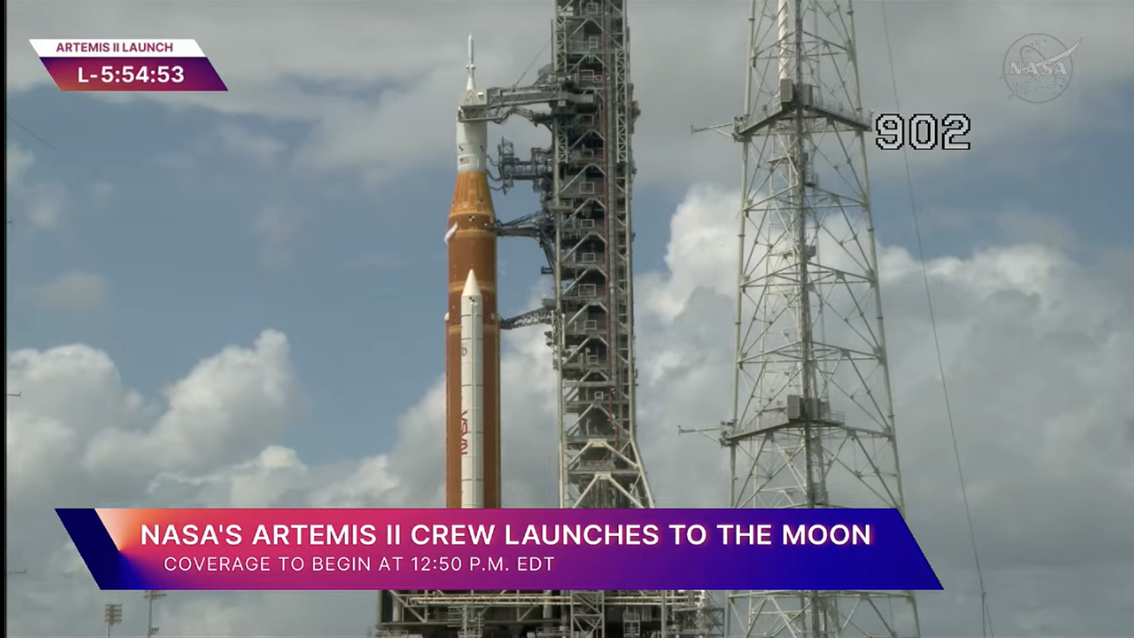
SCHAUMBURG – While watching a rocket blast off into space with three American astronauts and one Canadian is exciting, learning how one possibly rubs elbows with those that made those rockets at Technology & Manufacturing Association events is also inspiring.
Artemis II is NASA’s project that will send four humans to circle the moon and return after 10 days, following its April 1st launch from Florida’s Kennedy Space Center. The goal is for America to eventually make its way back to landing on the moon’s surface again – something that hasn’t been done Apollo 17 astronauts walked on the moon in December 1972.
Among those TMA members that have had a part in returning the United States’ aerospace emphasis to the moon is Acme Industrial, located in Carpentersville, IL.
Acme Industrial produces inserts and studs for Pratt & Whitney, as well as Aerojet Rocketdyne, for the four engines that power the Artemis II rocket, called the RS-25 Project. That participation makes Acme Industrial one of few companies with such hands-on experience and contribution to human space flight.
George Margelos, Acme Industrial’s President, said “ACME has a long history in supporting our country’s various space projects. This goes back to the days when the space shuttle was flying.”
Margelos told TMANews.com that on the second-to-the-last space shuttle mission, Pratt & Whitney came to Acme Industrial with a request to supply some urgently needed parts for the time-sensitive mission.
“They were quoted at a 44-week lead-time,” Margelos said. “They needed the parts in eight weeks. We delivered in six and continue to support the mission to this day.”
Another TMA member, Orion Industries of Chicago, IL, is unable to verify with TMANews.com due to NDA restrictions, but likely has also been a part of the Artemis II project.
Their contribution is another part that is crucial, but often understated. Orion Industries devised an ingenious method to accurately meet the strict requirements NASA sets for their rocket engine seals.
Orion shares the details on their website:
In aerospace propulsion systems, seals are silent workhorses. Hidden inside rocket and jet engines, they maintain pressure differentials, minimize leakage, and perform reliably amid extreme heat, vibration, and in some applications, extremely low cryogenic temperatures. Their performance is foundational to aircraft safety, efficiency, and mission readiness.
Each rocket engine contains dozens of precision seals. Across global aerospace fleets, from advanced space and defense platforms to commercial widebody aircraft, this translates into tens of thousands of seals operating continuously under demanding conditions.
Orion Industries goes on to point out the importance of these seals, designed for advanced rocket engine propulsion applications, where “reliability is non-negotiable.”
Each part features a crescent-shaped groove machined into a narrow, half-inch interior diameter. Every surface, including the seal’s recessed groove, requires complete, uniform coverage with a high-performance PTFE-based coating – and NASA’s specifications are especially challenging to meet.
Orion’s Scott Yoder, Regional Sales Manager and Technical Consultant, told TMANews.com, “At Orion, we understand that in projects like Artemis II, even the smallest components – like rocket seals – carry enormous responsibility, and our role in applying coatings with absolute accuracy is critical to the success of aerospace projects and their impact on humanity.”
The Technology & Manufacturing Association says it is proud to have members that play such crucial parts in America’s continuing journey into outer space.
“TMA members have always played a quiet but critical role in milestones like the Artemis II launch,” said Dennis G. LaComb, Executive Vice President & Chief of Staff of TMA. “The precision parts, materials, and expertise they provide power the supply chains behind NASA’s most ambitious missions and this nation’s exploration of space.
“It’s a powerful reminder that small and mid-sized manufacturers aren’t just supporting industry; they’re helping put us back on the path to the Moon and beyond,” he said.
Artemis II’s launch is currently scheduled for April 1 at 6:24 EST. Mission updates can be followed on NASA’s website at https://www.nasa.gov/blogs/missions/2026/04/01/live-artemis-ii-launch-day-updates/